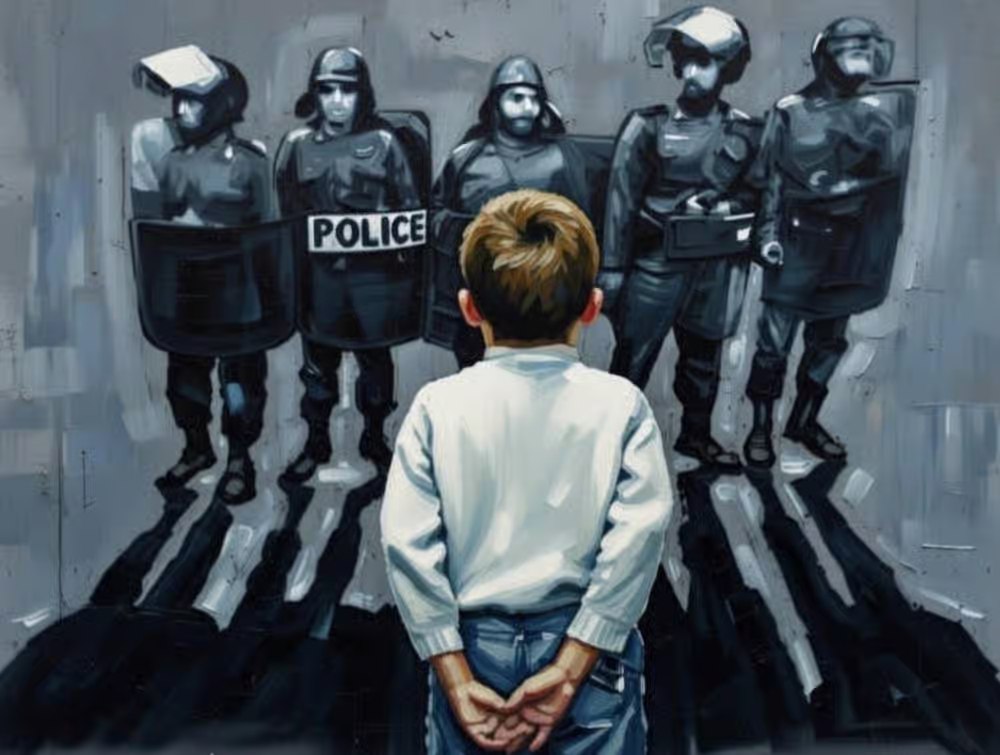
The Coordination Council of Teachers’ Trade Associations of Iran has expressed deep concern over the arrest of hundreds of children and adolescents under the age of 18 during the nationwide protests of Dey 1404 (January 2026), describing these actions as a clear violation of the Convention on the Rights of the Child and a “crime against the future of the country.” An unusually high concentration of arrests has been reported in Kohgiluyeh and Boyer-Ahmad Province, while reports of sexual abuse of detained children in Kermanshah have revealed even more alarming dimensions of the crackdown.
The council stated that the arrests, which have spread across several provinces, were carried out without transparent notification to families and constitute a blatant violation of children’s fundamental rights. According to reports received by the council on 5 January 2026, students such as Saha Davoudifar, Hessam Mohammadi, and Benjamin Mousavi, along with dozens of other adolescents, were arrested—raising serious concerns about their legal status and conditions of detention.
In Kohgiluyeh and Boyer-Ahmad Province, the scale of repression has been described as particularly alarming. At least 81 adolescents have reportedly been detained; 70 of them were transferred to the Juvenile Correction and Rehabilitation Center and Yasuj Prison, while 11 others are being held in security detention facilities, with no clear information available about their condition.
In Tehran and Alborz provinces, a significant number of adolescents have also been transferred to juvenile correction centers. In Khorasan Razavi Province—especially in Sabzevar—students have been sent to the Mashhad correctional center. In the city of Harsin, nearly 100 adolescents have reportedly been arrested, with their place of detention unknown. In Qom, at least 200 adolescent citizens have been transferred to prison without any announcement of their names or legal status.
The council emphasized that the scale of these arrests indicates a direct targeting of the younger generation, suppressing protests through physical force while endangering the future of society. According to this teachers’ body, schools, streets, and even hospitals have, in some cases, been turned into arenas of repression, with humanitarian and legal boundaries repeatedly violated—actions that may have long-term consequences for the mental health and rights of children.
Violation of Children’s Rights in Recent Protests
The Coordination Council of Teachers’ Trade Associations of Iran has described the arrest of children and adolescents as a blatant violation of children’s rights and a “crime against society and the future of the country.”
The Convention on the Rights of the Child is an international treaty adopted by the United Nations General Assembly in 1989 and ratified by nearly all countries in the world, including the Islamic Republic of Iran. This comprehensive document recognizes a wide range of civil, political, economic, social, and cultural rights for children (individuals under 18 years of age).
The Convention is based on four fundamental principles: non-discrimination; the best interests of the child; the right to life, survival, and development; and respect for the views of the child. Its primary aim is to ensure children’s well-being, education, and protection from exploitation and violence, recognizing children not as the property of their parents but as independent rights-holders.
States parties to the Convention are obliged to align their domestic laws and policies with its provisions and to allocate the necessary resources for the effective implementation of children’s rights. Key responsibilities include safeguarding the right to identity (nationality and name), ensuring access to healthcare and education, protecting children from abuse and economic exploitation, establishing a specialized juvenile justice system, and guaranteeing children’s participation in decisions affecting them.
States must also protect children in armed conflicts and eliminate all forms of discrimination based on gender, race, or social status. Under Article 44 of the Convention, governments are required to submit periodic reports to the UN Committee on the Rights of the Child regarding progress made in implementing these rights.
The Coordination Council has called for the immediate and unconditional release of all detained students, an end to judicial and security actions against them and their families, and transparent accountability by the responsible authorities. Reports indicate that many of these arrests were carried out without age differentiation and in public spaces, leaving families uninformed about their children’s whereabouts.
In a report titled “Children Behind the Bars of Repression,” the council published the names of identified detained students and adolescents in Yasuj, Kohgiluyeh and Boyer-Ahmad Province, including: Mohammad Mehdi Alipour, Amir Mohammad Bakhtiari, Farid Alizadeh, Hossein Khajeh-Yar, Erfan Bazdar, Reza Farhadi Sisakht, Ahmadreza Khaleghi-Pour, Mohaddeseh Mohammadi, Shahla Ansarian, Sanaz Davoudi, Anahita Hekmatnia, Zahra Darman, Shahreh Nik-Eghbal, Ainaz Parvaneh, Farnoush Azar, Shaghayegh Zahedi, Hadis Sheybaz, Elham Siavashi, Zahra Darfarin, Mojgan Forouzan, Yalda Pejvani, and Ghazal Hamzeh-Amleh. All have reportedly been transferred to the Yasuj Juvenile Correction and Rehabilitation Center, with the ages of most of them remaining unclear.
According to supplementary information from human rights sources, the number of detained students and adolescents in Kohgiluyeh and Boyer-Ahmad Province—particularly in Yasuj—is reported to be between 50 and 70, many of whom have been transferred to the Yasuj juvenile center. The council reiterated that the actual figures are likely much higher due to security pressure and internet disruptions. High-profile cases such as the arrest of 15-year-old Ilya Akvanian and 16-year-old Mahan Khouboni have also sparked widespread reactions.
Alarming Concentration in Kohgiluyeh and Boyer-Ahmad
According to the council’s findings, the highest number of child arrests occurred in Kohgiluyeh and Boyer-Ahmad Province, with 46 cases—significantly higher than in other provinces. Tehran ranked second with 18 cases, followed by Alborz with 17, and Mazandaran with 12. Gilan (5), Khorasan Razavi (3), and East Azerbaijan (3) followed. In other provinces, the number of detained children was reported to be very low, between one and two cases, including Isfahan, Kurdistan, Kermanshah, Khuzestan, Fars, Kerman, Hamadan, and Qom.
The unusually high concentration of detained adolescents in Kohgiluyeh and Boyer-Ahmad—especially in Yasuj—indicates the severity of repression in this region relative to its population and level of protests.
The Kurdistan Human Rights Network has also reported that it has so far obtained details of only 20 detained children and adolescents in the provinces of Ilam, Kermanshah, and Kurdistan. Meanwhile, the Coordination Council of Teachers’ Trade Associations of Iran reported the arrest of at least 100 student children during popular protests in the city of Harsin, Kermanshah Province.
In this context, two detainees in Kermanshah—one of them a child—told the Kurdistan Human Rights Network after their release that they were sexually abused by special police forces during their detention.
At the same time, a group of civil associations and organizations active in the field of children’s and adolescents’ rights in Iran issued a joint statement strongly condemning the violence inflicted on children and adolescents during the recent nationwide protests. These organizations, numbering more than twenty, expressed deep concern over the killing and injury of several children, emphasizing that such violence leaves irreparable physical, psychological, and long-term impacts on their lives.
They stressed that children, regardless of social or political circumstances, must enjoy fundamental rights to life, security, physical and mental health, and special protection. Under Iran’s Law on the Protection of Children and Adolescents, placing children in dangerous situations is prohibited.
Echoing the Coordination Council, these organizations emphasized that by signing the Convention on the Rights of the Child, the Iranian government has committed itself to guaranteeing children’s right to survival to the maximum extent possible. The arrest of children and adolescents therefore constitutes a clear violation of children’s rights, domestic laws, and international obligations.
They called for an immediate halt to violent برخورد with children and adolescents, the unconditional release of all detained children and adolescents, transparent and responsible investigations into cases of children killed or injured, and the provision of psychological, social, and medical support for affected children and their families. They concluded that lasting security, justice, and social calm can only be achieved through full respect for children’s rights and the guarantee of their human dignity.